Greece could significantly increase its income from the international golf market by expanding its infrastructure, according to a new study by the Foundation for Economic and Industrial Research (IOBE).
Released on Monday, IOBE’s report highlights that despite golf’s potential as a lucrative way to attract tourists, Greece remains underdeveloped in the sector.
The report, “The Contribution of Golf to the Greek Economy”, reveals that while golf is an established market worldwide, Greece has not fully leveraged its potential.
The study compares Greece to Portugal, a country with a similar economy that has capitalized on golf tourism. According to the report, Greece only has 10 golf courses, while Portugal boasts 113. As a result, golf contributes significantly to Portugal’s GDP, with an estimated value of 1 billion euros. In contrast, the contribution of golf to Greece’s GDP is just 111.4 million euros, suggesting that the country could gain an additional 880 million euros by developing its golf infrastructure.
Globally, golf is a thriving industry with over 62.3 million players and approximately 38,000 courses.
“The sport is strongly linked to tourism due to its high facility requirements and the fact that it attracts affluent travelers,” the report highlights.
Golf tourism also helps extend the tourism season of many destinations, as it typically takes place from October to May, boosting tourism during off-peak months.
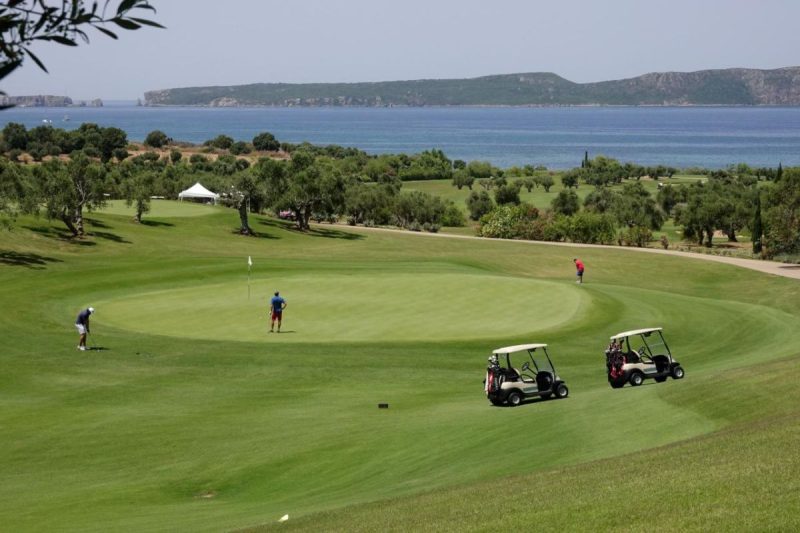
While the development of golf courses in Messinia has already shown positive results, the broader familiarity with the sport in Greece remains limited. According to the study, a critical mass of golf courses is needed to establish a region as a golf destination. Additionally, the development of golf facilities should be supported by adequate infrastructure, including year-round international air connections.
The study underlines that the growth of golf in Greece could extend the tourism season, attract higher-income visitors, and benefit the local economy. It could also have a positive impact on the real estate market.
Greece’s existing 10 golf courses, spread across Athens (Glyfada), Messinia, Crete, Halkidiki, and Corfu, have received international certifications and have helped enhance the tourism product. However, despite these efforts, Greece lags behind other Mediterranean countries like Portugal and Spain, which have maximized the potential of golf tourism.
In Spain, golf tourism generated 12.8 billion euros in 2018, and in Portugal, the Algarve region saw revenues of 370 million euros in 2017, supporting more than 16,000 jobs. The United States also benefits greatly from the golf industry, contributing $226.5 billion to the economy and creating 1.65 million jobs in 2022. The UK sees similar returns, with golf generating £2.7 for every £1 spent, with strong ties to tourism, real estate, and construction.
In Greece, however, golf’s contribution to the economy remains limited. In 2022, revenue from golf courses alone was estimated at 10 million euros, an increase from 6.35 million euros in 2019. Additionally, the total number of visitors to Greece who played golf in 2022 was around 50,000.
In conclusion, the IOBE study highlights the significant untapped potential for golf tourism in Greece.