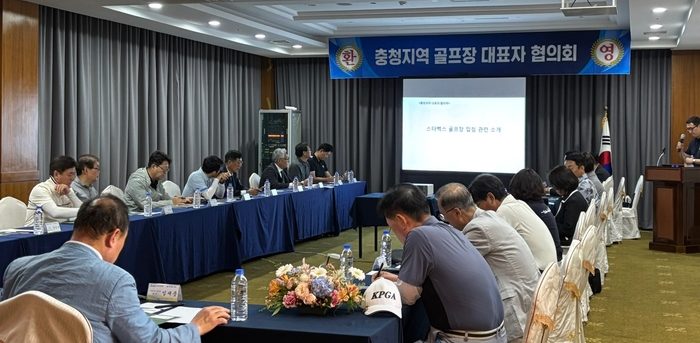
IMAGE: The Golf Course Management Association toured eight regional councils across the country and held regional meetings to discuss current issues related to golf courses. The photo shows a meeting of golf course representatives in Chungcheong Province. Korea Golf Club Management Association
The Korea Golf Course Management Association (KGMA) has successfully concluded a nationwide series of regional and consultative meetings designed to address pressing regulatory and operational issues affecting the country’s golf course sector.
Throughout June, KGMA toured eight key regional councils—South Gyeonggi, Eastern Gyeonggi, Northern Gyeonggi, Yeongnam, Honam, Chungcheong, Gangwon, and Jeju—meeting with course operators and stakeholders to assess current challenges and form a united front on pending legislative developments.
Central to the discussions were concerns surrounding proposed revisions to the Act on the Installation and Use of Sports Facilities, commonly known as the “Chest Act.” The most contentious issue under review was a possible reclassification of golf courses as women-only sports facilities—a move industry leaders argue could lead to significant operational and legal complications.
“We agreed that a collective, association-level response is essential,” the KGMA stated. “There is widespread concern that such a reclassification could create unforeseen issues for golf course operations and the broader golfing ecosystem in Korea.”
KGMA also provided vital legal updates for course operators, including new obligations related to music copyright fees. Under current regulations, golf courses must pay for the use of background music in areas such as clubhouses, parking lots, and on-course shade shelters. The association emphasized the importance of compliance and offered guidance on managing these fees.
The meetings also delved into legal reviews of surveillance and safety technologies. As part of its ongoing mission to ensure customer and staff safety, the association evaluated the legality of installing black box cameras or caddy body cams in golf carts. This measure, still under discussion, is seen as a proactive step to reduce incidents and enhance transparency on the course.
Another topic of interest was the issue of “green blood” treatment standards—an industry term referring to the handling of players who exit the course mid-round without completing play. Establishing uniform standards for such situations is seen as a necessary step to protect both course integrity and revenue management.
In addition to the regional forums, KGMA hosted a high-level advisory and executive meeting on June 16 at Volcano Country Club in Yongin, Gyeonggi Province. The event saw the appointment of new advisors to help steer the strategic direction of the association. These included Hanalsam, Chairman of Gimpo Cide Country Club and a former KGMA president; Woo Ki-jung, Chairman of Daegu Country Club; and Park Jung-ho, Chairman of Pristin Valley.
According to the association, the advisory group plays a vital role in offering strategic counsel, particularly during a time when the Korean golf industry faces both regulatory uncertainty and new growth opportunities.
Choi Dong-ho, Chairman of KGMA, highlighted the symbolic importance of these appointments and the advisory system itself.
“The advisory system serves to inherit the spirit of the 'Best Senior of the Association'—those who have shaped the past and present of our industry,” said Choi. “It also strengthens the legitimacy of the Korea Golf Course Management Association as it prepares to lead the next chapter of the K-golf industry.”
With more than 500 golf courses in Korea and a rising global profile, KGMA’s efforts reflect a broader push to ensure that the country’s golf sector remains competitive, compliant, and forward-thinking in a changing regulatory landscape.
As the Korean golf boom continues, these meetings underscore the importance of cohesive leadership and ongoing dialogue between regulators, operators, and industry advocates. The KGMA has positioned itself as a key player in safeguarding the industry's future—while embracing innovation and legal clarity as part of its roadmap forward.