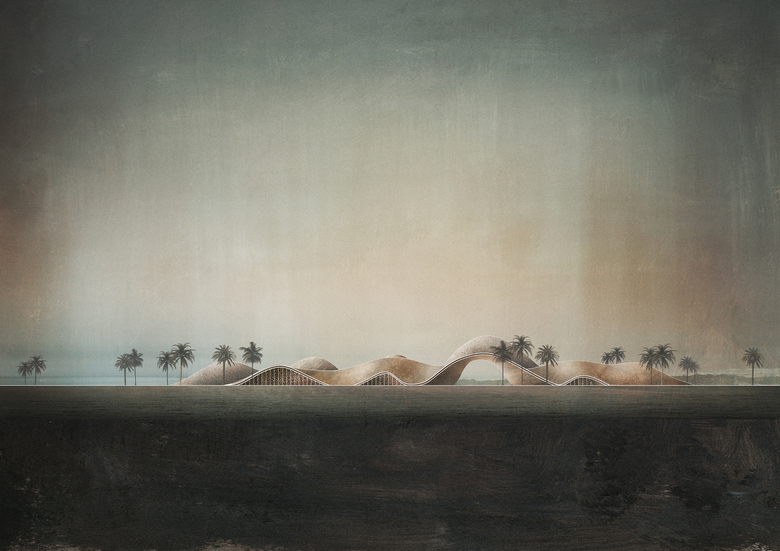
AQABA, JORDAN – In the heart of the $1.4 billion Ayla Oasis, a new architectural marvel is rising from the sand, bridging the gap between ancient landscapes and futuristic sustainability. The Ayla Golf Clubhouse, part of a massive mixed-use resort on the Red Sea, has officially set a new standard for "silent, poetic structures" in the Middle East.
Located at the strategic intersection of Jordan, Israel, Egypt, and Saudi Arabia, the clubhouse serves as the crown jewel of an 18-hole championship course designed by Greg Norman. But while the greens are world-class, the building itself is stealing the spotlight.
The design team sought to create a structure that didn't just sit on the land, but emerged from it. Drawing inspiration from the rolling dunes and the nearby mountains of Petra, the architects utilized a "lift and carve" philosophy.
"With such beauty and a strong sense of place, we looked to the undulating dunes of the coast to see how we might 'lift' and 'carve' the desert to create silent, poetic structures," the design team noted.
The result is a dynamic concrete shell that drapes over the interior spaces like a frozen wave, creating a singular, continuous surface that serves as both roof and wall.
The construction of the clubhouse was a masterclass in global-local collaboration. Rather than relying on heavy industrial machinery, the project prioritized human skill and local economic impact.
The clubhouse is literally made of its surroundings. The concrete shell was mixed with soil from the site and doused in local minerals and pigments by an Aqaba artist to ensure the color palette perfectly echoes the surrounding mountain range.
| Feature | Design Inspiration |
| Exterior Form | Undulating coastal dunes |
| Natural Cooling | Openings positioned to capture Red Sea breezes |
| Light Filtration | Perforated Corten steel screens (inspired by traditional mashrabiya) |
| Pattern Work | Triangular openings based on Jordanian cultural motifs |
The Ayla Golf Clubhouse is more than just a facility for athletes; it is a visceral piece of art. By shunning ornate decorations in favor of raw, unadorned materials and rustic metals, the building manages to feel both ancient and avant-garde.
As a major driver for tourism and economic growth in the region, Ayla is proving that high-end luxury can be socially and environmentally sustainable. In the words of its creators, the architecture does more than provide shelter—it "captures the elemental beauty of the rolling desert landscape."