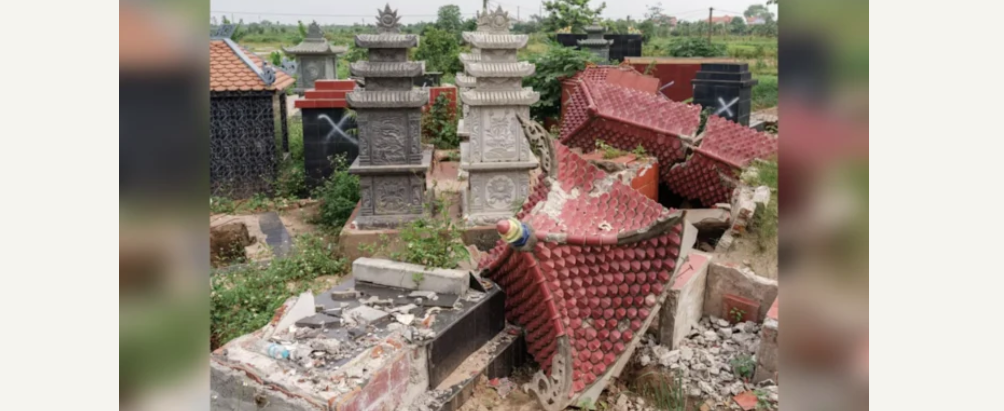
HUNG YEN, Vietnam — A major $1.5 billion golf course and luxury development linked to the Trump Organization and its local partners has sparked widespread anger and distress in northern Vietnam, where farmers are being forced to exhume ancestral graves to clear land for the project.
The massive development, spanning approximately 990 hectares in Hung Yen province, has led to the systematic dismantling of a long-standing rural cemetery. The site currently shows heavily disturbed graves, broken nameplates, and markings indicating where remains have been relocated, leaving local villagers to grapple with a severe emotional and spiritual toll.
"It's a spiritual thing, people don't want to disturb the graves," said local farmer Tran Minh Hai.
The project is widely viewed by analysts as politically significant, arriving at a critical juncture as Hanoi works to strengthen economic and diplomatic ties with Washington. The development was fast-tracked by Vietnamese authorities amid broader trade tensions with the United States.
Under the Trump administration, the US had previously threatened tariffs of up to 46% on Vietnamese goods before later reducing them. Analysts note that Vietnam’s export-heavy economy is uniquely sensitive to such American economic pressure.
"There is a growing sense that Vietnam needs to do more in order to please the Trump administration in terms of trade, tariff and intellectual property concerns," said Nguyen Khac Giang, a visiting fellow at the ISEAS Yusof Ishak Institute.
When completed, the luxury complex is expected to feature five-star hotels, ultra-luxury villas, and a high-end golf course. Local officials argue the development will ultimately boost regional jobs and tourism. However, critics counter that the project directly threatens fertile farmland and long-standing rural livelihoods.
Despite government-approved compensation and resettlement plans, the project faces intense resistance from more than 4,000 affected households. Many residents are flatly refusing relocation or demanding significantly higher payments for their property.
For many villagers, the initial optimism surrounding the project has completely evaporated into sorrow and outrage.
"When they [first] told us about the golf project, the people were excited and supported the project for the development of the country," said resident and farmer Nguyen Duc Theo.
Instead, the reality of moving ancestral remains has fractured the community.
"It's painful," said Hoang Do, another resident affected by the grave relocation. "I'm outraged by the compensation price."
For others, the forced relocation feels like a betrayal of their deep historical roots to the land.
"The grave of my great-grandparents has been there since 1967, before the establishment of this country… so why should I move them?" asked local resident Hoang Anh Xa.