Interview by Mike Orloff
When it comes to forward-thinking leadership in golf, few names carry more weight in Asia than Andy Johnston, General Manager and Director of Agronomy at Sentosa Golf Club in Singapore.
From hosting world-class events like LIV Golf to being the first golf club in the world to sign the UN Sport Climate Action Initiative, Sentosa is not just playing the game; it’s changing it.
In this exclusive interview, Mike Orloff sits down with Andy to discuss the club’s approach to entertainment, environmental responsibility, and why cultural alignment is critical to long-term success.
Mike Orloff: Andy, this is Sentosa’s fourth year hosting a LIV Golf event. What’s behind your decision to align with LIV, and how has the experience been?
Andy Johnston: LIV presented an opportunity we couldn’t ignore. From the start, it was about embracing golf as entertainment. Most professional sports already integrate music, fan zones, and in-game content, but golf has been slow to get there. LIV is pushing that envelope. Sure, the format’s different and it’s stirred controversy, but it’s generating conversation, and that’s a good thing for the sport.
We’ve hosted over 40 televised events here, and Asia doesn't get enough of this level of golf. So LIV became an exciting way to bring world-class golf back to this part of the world.
MO: There’s been some tension between LIV and the PGA Tour. What’s your take on how that’s unfolded?
AJ: Perhaps it can be argued that the PGA Tour missed a chance to evolve, although they’ve made plenty of changes in the past few years, which everyone can see was because of the emergence of LIV. Their initial handling and stance didn’t leave much room for collaboration or an open dialogue about what LIV was setting out to achieve. I do think the game of golf needed a shake-up, though, and LIV delivered that. I do understand it both sides. However, from where we sit, it’s about offering fans a great experience and making the game more accessible, especially in Asia, where we’re often left out of the bigger conversations.
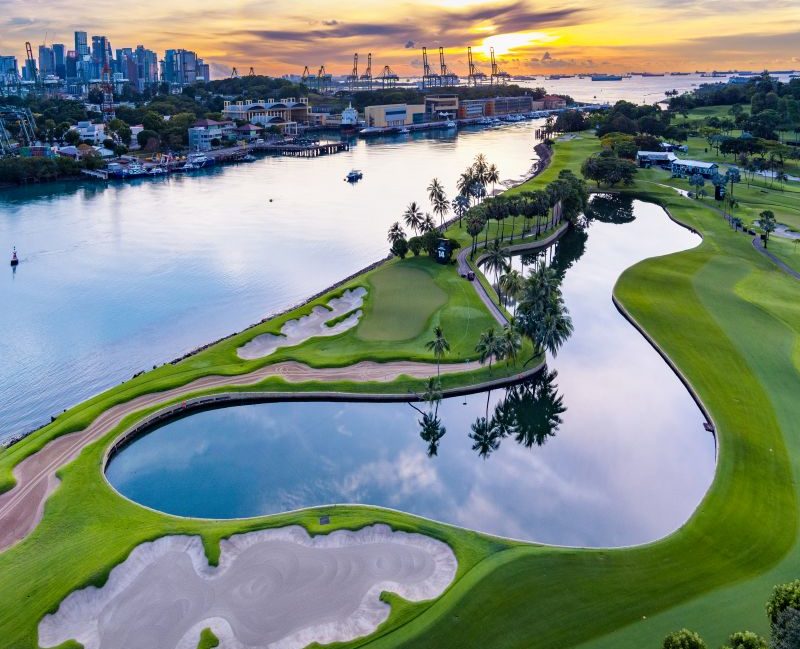
MO: Let’s talk logistics. Sentosa has a reputation for world-class course conditions—even under pressure. How do you prepare the course for these elite events?
AJ: We’ve invested heavily in infrastructure such as SubAir systems, advanced drainage and a lot of high-end equipment. When you’re hosting a shotgun-start professional event like LIV, every green needs to be the same speed at the same time. That’s a massive operational challenge.
We don’t have the luxury of shared equipment or regional support like some clubs in the U.S. Everything has to be owned and maintained in-house. But it’s worth it. It allows us to reset the course quickly, even after a tropical storm.
MO: You’ve also made global headlines for your environmental leadership. What’s the biggest challenge Sentosa faces in sustainability?
AJ: Energy consumption, by far. Course equipment gets a lot of focus, but running the clubhouse, charging over 120 carts and operating two massive pump stations...that’s where the footprint really adds up.
We’ve looked at case studies from football clubs in Ireland who went nearly 100% solar. That’s the kind of thinking we need in golf. We're now trialling solar tile technology from Korea and Spain. Very new, and potentially a game-changing option in that space.
MO: Sentosa was the first golf club globally to sign the UN Sport Climate Action Initiative. What led to that move?
AJ: That came through Jonathan Smith at GEO Foundation. I was shocked to learn no golf club had signed, or even really seemed interested in exploring. Golf touches so many people globally, so I thought why aren't we more involved?
Professional sports like football and tennis have been on board for years. For us, it was about leadership. Someone had to go first, and we were happy to step up. I just wish more golf clubs would follow.
MO: Sustainability often comes with a price tag. How do you manage the economics of going “green”?
AJ: You’ve got to take a long view. Our single-head irrigation control system cost about $6 million. That’s not a small number. But when you consider the water and energy savings, and the improved playing conditions, it pays off over time.
We also replaced bottled water with refill stations. Members pushed back at first, but once staff explained the reasoning, they got on board. That cultural alignment, among staff, board and members, is essential.
You’ve implemented numerous on‑course sustainability measures: single‑head control irrigation (≈40 % water reduction), rechargeable lithium‑ion buggies, biochar, food‑waste digesters, stingless bee colonies, native species preservation etc.
That signing in 2020 sparked a pioneering journey in sustainable golf, one that’s seen Sentosa take bold steps toward reimagining what climate leadership in the sport looks like.
Our key milestones since then include an EV partnership with Porsche, a 10-year agreement with Toro to bring battery and hybrid powered turf equipment to Sentosa (we are also a Toro Centre of Excellence in Asia), and a new fleet of lithium buggies from E-Z-GO which are 15% more efficient that competitors.
MO: What’s your advice to clubs just starting on their sustainability journey?
AJ: Start by measuring your carbon footprint. You can’t manage what you don’t track. Then engage your team. They’re the ones who'll carry it forward. Celebrate the small wins. Build momentum. And don’t worry about being perfect, just be better than yesterday.
MO: You’ve mentioned a shift toward organic carbon neutrality. What does that look like for Sentosa?
AJ: Initially we asked golfers to contribute a dollar toward carbon credits to offset their rounds.
Now, we’re focused on achieving carbon neutrality organically. That’ll take a few years, maybe two to five. Solar is a big part of that, as is reducing energy and input usage. It's slower, but more authentic.
MO: You’re also experimenting with biochar. Can you break that down for us?
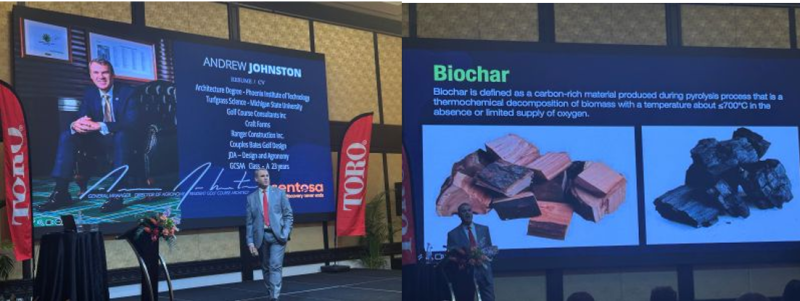
AJ: Biochar is ancient technology, used by the Incas, actually. It’s what’s left after burning organic material at high temperatures in a low-oxygen environment. It’s not a fertilizer, but it improves soil structure, which helps roots absorb nutrients more efficiently.
We started with liquid biochar from a company in the Carolinas (USA), partially backed by Justin Timberlake, believe it or not. Now we use granular forms made locally in Singapore. We’ve cut NPK fertilizer use by 50% in some areas. That’s huge.
MO: Any industry leaders you look to for inspiration?
AJ: Definitely Shannon Easter Broken Sound Club in South Florida. That guy is ahead of the curve, from biochar to composting, you name it. South Florida is kind of the epicentre for innovative thinking in turf management. We share notes quite often.
MO: One of the things you’ve said in the past is that the golf experience can’t suffer for the sake of sustainability. Can you expand on that?
AJ: Absolutely. People come here to play great golf. If you lose sight of that, the rest doesn’t matter. Our job is to deliver an exceptional golf experience, and do it in a way that’s smart for the environment.
The good news is that the two don’t have to conflict. In fact, they often complement each other. Healthier turf, smarter inputs, more natural playing surfaces, they enhance the game.
MO: What’s your vision for the future of golf?
AJ: I want golf to shed the elitist label and become recognized as a community asset. A place where people play, but also cool down during heat waves, connect with nature, and feel welcome.
We have the land, the reach, and the visibility to lead in this space. It’s time we step up, not just for golf’s sake, but for the planet.
MO: Andy, thanks so much for your time, and for all you’re doing to lead the golf industry forward.
AJ: Appreciate it, Mike. The more we talk about this stuff, the more change we’ll see.