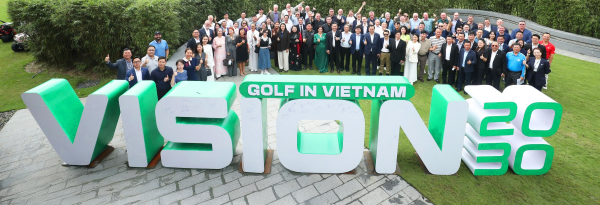
Since 2010, Ive been traveling to Asia for various industry events. Even a decade ago, there was always a low hum of conversation, a persistent talk about Vietnam being the "big one, destined to take off as a global golf destination truly.
At that time, China was on everyone’s mind because it had numerous opportunities unfolding (we thought). However, since 2010, things there have shifted significantly, with course closures and a changing attitude toward golf venues and tourism in the Chinese industry.
We had been publishing many articles on Golf Industry Central, but we never really saw it take off like it was supposed to.
Vietnam has spent the last few years quietly resurrecting itself into a dominant force. From what I’ve seen over several trips in the past couple of years, including some with my family, it’s a safe, enjoyable, and inexpensive destination that is finally finding its feet.
Vietnam wason track to generate US$1 billion in golf tourism revenue in 2025, according to the Vietnam National Authority of Tourism (VNAT). The milestone would see golf contribute 8–10 percent of the nation’s total tourism revenue, highlighting the sport’s growing importance as a strategic driver of high-end travel.
Vietnam has already cemented its reputation as one of Asia’s premier golf destinations, with over 80 internationally accredited courses and a stream of accolades from the World Golf Awards, including “Asia’s Best Golf Destination” for eight consecutive years (2017–2024) and “World’s Best Golf Destination” in 2019 and 2021. Hanoi, meanwhile, was named “World’s Best Golf City Destination” in both 2023 and 2024.
But as I’ve often said, the challenge hasn’t just been the quality of the courses; it’s been the lack of formal industry infrastructure. While there are roughly 80 courses now, the "industry" side of things hasn't always been coordinated or, more importantly, "structured" for the growth that is potentially coming.
That’s why my recent visit to the Vietnam Golf Course Owners Summit 2025 felt like a strategic turning point, especially as business partner Sean Plunkett had launched www.golfindustry.asia in late 2024 and we had a renewed focus on Asia as a whole. There is a new energy on the ground, and it feels like Vietnam is finally entering a defining decade for golf and leisure development. We are excited to be involved!
The trip kicked off with an invitation from Ben Styles and Dandelly Nguyen of 54 Vietnam. I’ve known Ben for many years, as he’s an Aussie PGA member originally from Brisbane who has spent nearly 20 years in Vietnam and was instrumental in marquee projects like The Bluffs Grand Ho Tram, a few hours from Ho Chi Minh City, and Hoiana Shores Golf Club in Da Nang.
The goal of their latest initiative is simple but massive: getting golf course owners to work together for a better national outcome, more jobs, increased tourism, and a coordinated conversation on how to sustainably grow another 100 venues. Vietnam is already reportedly hitting the US$1 billion mark in golf tourism dollars, but much of that was "luck" until recently. Now, there is a real, professional effort to put the country on the map permanently.
My business partner from Golf Industry Asia, Shaun Plunkett, and I headed to Da Nang in October for the summit. I popped over from the AGIF Conference in Kuala Lumpur the days before.
It was held at the stunning Laguna Golf Resort Lang Co in Hue 1.5hours north of Da Nang. It wasn't just a meeting; it was a gathering of government leaders, owners, and international experts synchronizing a vision for the future.

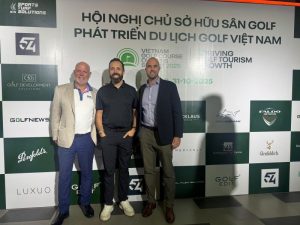
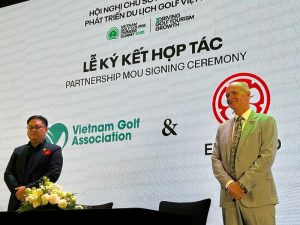



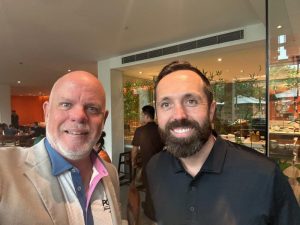

Jed Moore’s keynote address served as a manifesto for the industry. He challenged the room to look beyond the sport itself and use golf as a catalyst for a national strategy.
"Golf is not the destination. Golf is the starting point," Moore stated.
He believes that if Vietnam remains committed to this vision with clarity and purpose, the country can absolutely be recognized as a Global Sports Nation by 2040. It’s about coordinated action across ministries, investors, and communities under one shared vision.
We spent two days listening to Jed Moore (Founder and 54 Group CEO), Ed Edwards, and the rest of the team share the big-picture vision along with many other industry leaders from Vietnam, Asia, and international.
54 is playing a massive role here, helping with everything from planning and building to staff training. There were several panel discussions throughout, as well as plenty of social time to catch up with industry colleagues.

Jed Moore (Keynote)
What struck me most was the level of government support; this was a summit with real "teeth". Directed by the Ministry of Culture, Sports and Tourism, the event saw Deputy Minister Hồ An Phong emphasize that golf is now an integral part of Vietnam’s strategy for high-quality, sustainable tourism development.
Looking toward 2030, the Ministry envisions golf as a premium product and a composite economic sector spanning culture, sports, and tourism. They aren't just building courses; they are building a "Golf Vietnam" brand rooted in cultural identity. A key part of this is the push for National Golf Destination Clusters. They want regional links—particularly in Central Vietnam and Hue, to form a nucleus of golf, luxury resort, cultural, wellness, and local experience offerings. This is a concrete step towards realizing the Vietnam Golf Vision 2030, building a sustainable, globally integrated industry.


The roadmap for 2025–2030 is built on three specific pillars discussed at the summit:
We sat in on panel discussions featuring heavy hitters from England Golf, 54, Golf Course Association Europe, LIV Golf, Asian Tour, Toro, Club Car, and Faldo Design. Topics included designing the 2030 strategy and building Vietnam golf for the "Next Hundred".
The consensus? The true value of a destination lies not in individual courses but in the ability to create a unified, world-class experience.
There was a panel of many high-profile industry people speaking, some of the real global experts in this space. A full breakdown available here.
On the media side, it was great to see Rick Shiels, LIV Golf ambassador and world-famous content creator, highlighting the role of digital media. His take was simple: "Golf must become part of life, not just a sport. This modern approach is exactly what’s needed to bring Vietnam’s golf image closer to global audiences and younger generations."
The local commitment is just as strong. Mr. Nguyen Thanh Binh, Permanent Vice Chairman of the Hue City People's Committee, reaffirmed their commitment to developing golf tourism in harmony with cultural preservation. In Hue, with its iconic heritage and landscapes, golf is a way to reflect ambition while connecting local communities and international visitors.
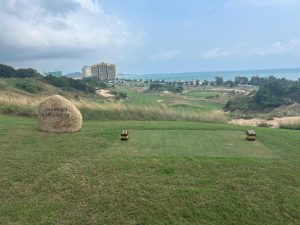
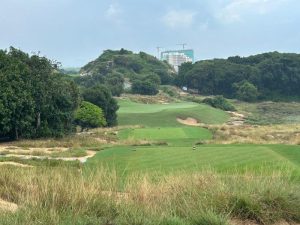
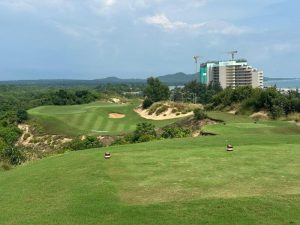
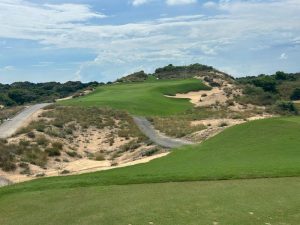
Of course, you can’t visit Vietnam without getting some grass under your feet. After the summit, we headed to NovaWorld Phan Thiet Golf Club, managed by Nova Golf Club, with 54 recently providing advice and direction to get the property back in shape. It's had a rough time (no pun intended) since the Covid hit, but it has the bones of a great facility, so it won't be long till you see it back in pristine condition.
It is a premier 36-hole destination located within the expansive 1,000-hectare NovaWorld Phan Thiet complex in Vietnam. Designed by Greg Norman, the facility serves as a world-class hub for both amateur and professional golfers.
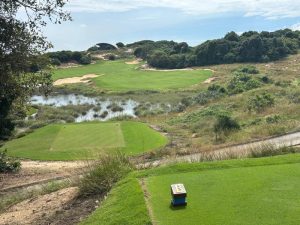
The facility comprises two distinct 18-hole championship courses. The PGA Ocean Course is a 7,400-yard layout that blends parkland and links styles. It is characterized by rugged bunkers, native grasses, and undulating fairways that offer panoramic views of the East Sea. In contrast, the PGA Garden Course is a 7,200-yard parkland design inspired by the "Sandbelt" region of Melbourne. It features strategically placed water hazards, a meandering stream, and a dramatic waterfall finish on the 18th green, making it a rigorous test of accuracy for all skill levels.


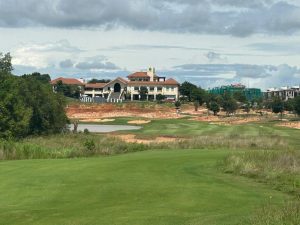
However, Ho Tram also highlights the current infrastructure gap. There’s only one course, with maybe a second one to come in the future, in that specific location, so it’s not a "true" multi-day destination as of yet. They need a couple more facilities, much like the rest of Vietnam, where there are small pockets of courses, but the infrastructure to get Westerners out there is still developing. It is a long commute to Ho Chi Minh City, but reports show some new highways are planned to cut the 3-hour trip.
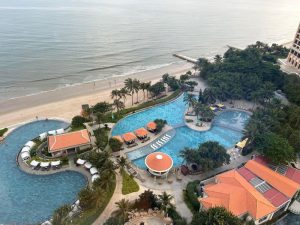


I want to say a huge thanks to Ben and Dandelly for inviting us. We hope to be back again in 2026 to be more involved in this industry growth.
Attending the Vietnam Golf Course Owners Summit signals such a clear intent for the future; it excites me for what’s coming in 2026 and beyond. Vietnam has the vision; now it’s all about the execution. The "defining decade" for Vietnam golf has officially begun.