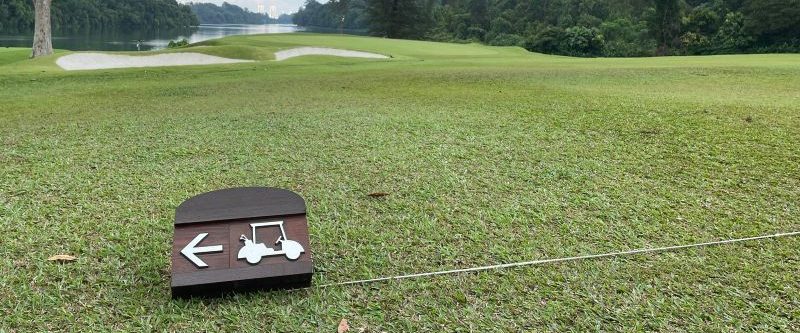
Singapore, 26 June 2025 — In an era where environmental responsibility is becoming an essential part of golf course operations, The Singapore Island Country Club (SICC) is taking bold steps to redefine what sustainable golf can look like in Asia. Through a Tree Repurposing and Protection Programme, the club is converting fallen trees into functional course fixtures, setting a high bar for the region’s golf industry.
The initiative sees mature tree trunks and limbs, felled due to age, storm damage, or course redesign, transformed into buggy exit signs, fairway distance markers, and tee markers. The result is a golf environment where nature is not only preserved but thoughtfully reintegrated into the course’s design and daily use.
“As stewards of one of Singapore’s largest and most ecologically rich golfing landscapes, we wanted to turn what was once considered waste into something meaningful,” said Mr Tai Wae Meng, Director of Golf Course Management at SICC. “Some of these trees have stood for decades and hold deep historical and ecological value. Repurposing them allows their story to continue while reducing our environmental footprint.”
With over 6,000 trees across 63 holes and three golf courses, SICC is one of Singapore’s most tree-rich clubs. Instead of disposing of fallen trees off-site, a process that involves transport emissions and contributes to landfill use, the club has committed to reusing the timber directly on the course. This not only reduces carbon emissions but also lessens the need for synthetic or polyethylene-based materials.
“We’re supporting Singapore’s broader goal to extend the lifespan of Pulau Semakau, our only landfill,” Mr Tai Wae Meng added. “At the same time, we’re reducing material costs and carbon-intensive procurement practices.”
The environmental and operational benefits are twofold: the club eliminates the cost and emissions associated with hauling and disposing of large tree debris, while also creating bespoke, high-quality course furnishings from natural materials.
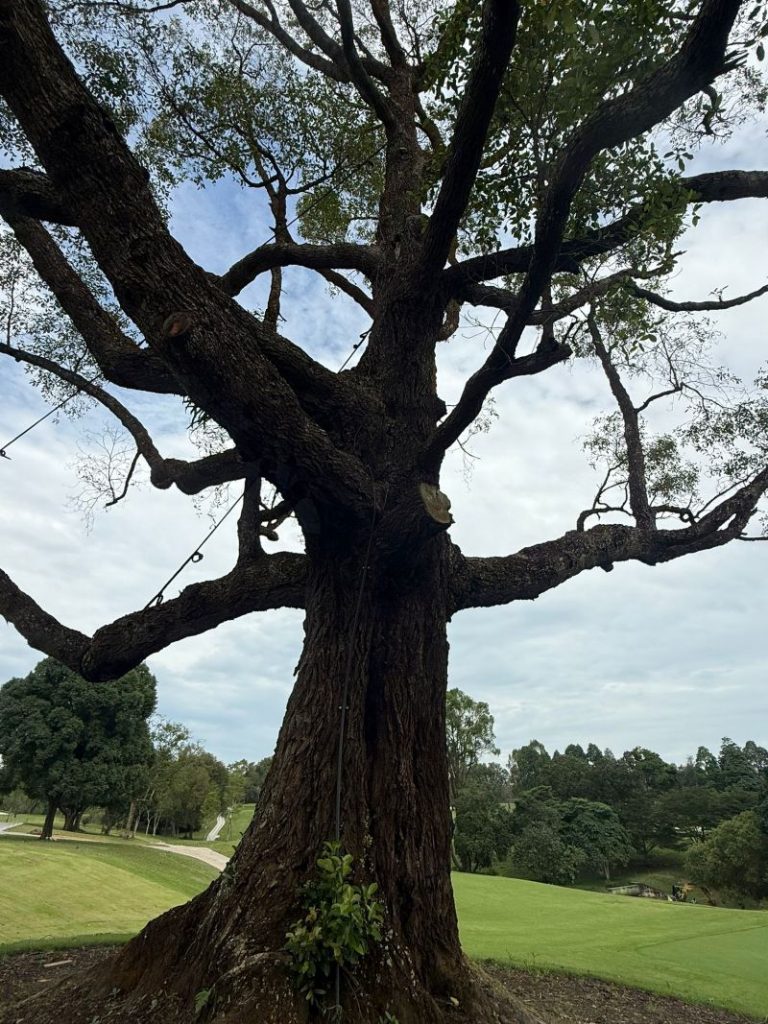
SICC’s approach to tree management is both strategic and conservation-minded. Trees are only removed when deemed a hazard or when they obstruct playability. Where possible, the club prolongs tree life using tilt sensors, lightning protection systems, and structural bracing. Trees considered for repurposing must have a minimum girth of 30 cm.
For example, a mature Tembusu tree near Hole 5 on The Island Course is protected by a copper lightning rod system designed to safely ground any strikes, preserving both the tree and the surrounding course elements. Other trees are supported with braces to reduce stress on key limbs during high winds and storms.
This thoughtful approach to arboriculture reflects a broader philosophy at SICC: that trees are not obstacles to be cleared but assets to be protected, repurposed, and celebrated.
Once a tree is designated for reuse, its timber is carefully cut, air-dried, and processed by a local woodworking vendor. The logs are shaped, machine-engraved with coarse information, and hand-painted to maintain the wood’s natural grain and character. The finished products—ranging from distance markers to tee boxes and exit signs—blend seamlessly into the landscape while telling a story of sustainability and renewal.
These natural, handcrafted elements are already visible across the recently upgraded Bukit Course and will feature prominently in the redesigned Island Course, scheduled to reopen in late 2025.
“This programme started as part of the Bukit Course’s centenary celebrations in 2024,” said Mr Tai Wae Meng. “As we redevelop the Island Course, we’re building on that legacy and expanding the scope of what repurposed materials can do on a golf course.”
SICC’s sustainability initiatives have earned recognition from the International Golf Environment Organisation (GEO), and the club is home to two NParks-endorsed Heritage Trees, highlighting its commitment to biodiversity and ecological stewardship.
Rather than simply removing trees for construction, the club often transplants them on-site, ensuring they continue to contribute to the ecosystem. These practices support natural processes such as nutrient cycling, shade regulation, habitat preservation, and carbon sequestration—all of which play a role in building climate resilience.
“Golf courses are often misunderstood as being at odds with nature,” said Mr. Ian Geoffrey Roberts, General Manager of SICC. “Our work demonstrates that with thoughtful planning and a long-term view, golf can coexist with—and even enhance—its natural surroundings. By repurposing and replanting trees, we’re not just preserving biodiversity; we’re contributing to a more resilient environment.”
SICC has plans to expand its tree reuse programme shortly. Beyond course fixtures, future applications may include custom-made furniture, directional signage, and organic mulch—all crafted from salvaged timber. These steps aim to create a fully circular system where natural materials are retained and reused within the club’s ecosystem.
As the Island Course redevelopment progresses, SICC remains committed to embedding sustainability into every stage of its operations, ensuring that from trees to tees, the golf experience is built on principles of care, conservation, and continuous improvement.
This initiative positions The Singapore Island Country Club as a leader in eco-conscious course management and a model for how Asia’s golf clubs can integrate environmental stewardship into both their design and operations.
Related Stories