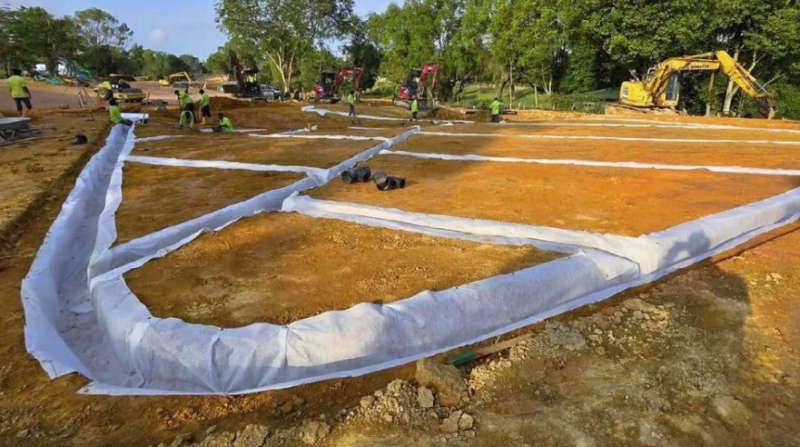
Singapore Island Country Club (SICC) will partially reopen its historic Island course in the summer 2025, with the back nine becoming available for limited play following an extensive renovation by Nelson & Haworth.
This S$30 million (US$22 million) project represents the final design work of the late Neil Haworth and is being directed by Brett Mogg, longtime partner at Nelson & Haworth.
“Golf in Singapore has faced significant pressure recently, with several courses closing,” explains Mogg. The Singapore government’s ongoing land use review has reduced golf course numbers, with further reductions expected over the next decade. “SICC recognized the need to renovate the Island course to maintain its position as Singapore’s premier private club and provide more all-weather options for members. Despite being beloved, the Island course’s old-style clay-based and cowgrass design frequently closed due to wet conditions.”
Originally designed by Scottish professional Peter Robertson, the Island course opened in 1932. Australian legend Peter Thomson implemented changes, including rebunkering, in the late 1990s and early 2000s, with only minor updates since then.
Nelson & Haworth’s renovation aims to enhance playability, walkability and drainage while preserving the course’s historical character. This project follows the club’s 2017 Bukit course renovation and the 2021 creation of a 27-hole New course replacing two former 18-hole layouts.
“Our work involves reducing steep fairway slopes and inaccessible areas, implementing sandcapping to manage tropical rainfall, installing new drainage systems, preserving playing corridors and mature trees, making limited routing adjustments, enhancing views of Pierce Reservoir, and maintaining the course’s traditional aesthetic through new push-up style greens and EcoBunker’s revetted bunkers,” Mogg details. “We’ve also incorporated full cart path access for older members while improving overall walkability.”
TEHC International is handling construction, with Chris Gray, the R&A’s head of sustainability and agronomy for Asia Pacific, serving as consultant. Ivan Chua, chairman of the redevelopment project committee, oversees the project for SICC.
Key walkability improvements on the back nine include:
The most significant changes appear in the 11-13 stretch:
At the 11th hole, the cross slope has been completely eliminated, with the former u-drain along the right fairway raised and transformed into a natural stream. The green has shifted left to create a slight dogleg, and a new back tee extends the hole to a true par five for skilled players.
The 12th hole now plays as a long downhill par three to a green guarded by two rectangular bunkers and a water hazard on the left, with a generous bailout area to the right. The par-four 13th features elevated tees playing to a fairway that rises to a green framed by mature trees.
Another notable change comes at the 16th hole, now the course’s longest par three, with large trees flanking the fairway adding character and challenge. A Redan green template design enhances the hole’s strategic elements.
Primo Zoysia grass from Sports Turf Solutions (STS) has been selected for tees and greens. “It performs exceptionally well on tees receiving limited direct sunlight,” notes Nigel Taylor, STS general manager. “The same applies to greens with restricted sunlight exposure. The nutritional program for both greens and tees is approximately 75 percent Floratine, possibly more.”
The renovation includes several technological upgrades:
The project team includes irrigation specialist Aqua Turf International, civil engineer JYC Consultants, and surveyor WT Partnership, with Centaur Asia Pacific assisting with materials delivery.
Work on the front nine continues, with full project completion expected by the third quarter of 2025.
CREDIT: Golf course Architecture