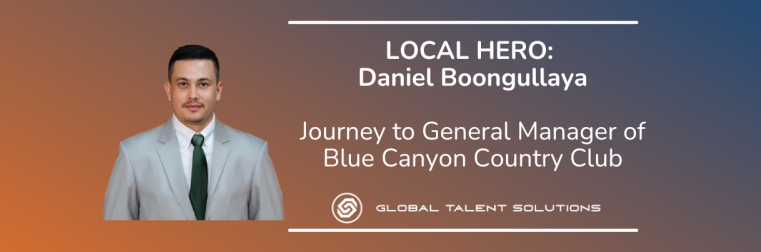
By SEAN PLUNKETT - In the competitive landscape of Thai golf management, where senior roles have long been dominated by expatriates, Daniel Boongullaya stands out as a rising local leader. At 38, the half-Thai, half-Swedish General Manager of Blue Canyon Country Club in Phuket embodies a new generation of talent. His story—from childhood passion on the fairways to steering one of Thailand’s most storied clubs—offers valuable insights for the industry, particularly on developing local professionals, reinvesting in aging facilities, and adapting to shifting tourism patterns.
Blue Canyon Country Club, just 10 minutes from Phuket International Airport, features two championship courses designed by Yoshikazu Kato: the Canyon Course (opened 1991, named Thailand’s Best Golf Course at the 2024 World Golf Awards) and the Lakes Course (1999). The club has hosted major events, including the Johnnie Walker Classic (won by Greg Norman in 1994 and Tiger Woods in 1998), European Tour and Asian Tour tournaments, and serves as an official partner of the Korean Ladies Professional Golf Association (KLPGA).
Early Roots and the Shift from Player to Manager
Daniel’s love for golf began at age six when his father introduced him to the game. Like many young players, he dreamed of turning professional. He did turn pro but quickly realized the path would not support a family. “You’re not good enough basically, right? And it can’t support your family,” he recalled candidly.
He pursued formal education in Australia, completing a Diploma of Sports Development in Golf on the Gold Coast. While there, he worked at Robina Woods, gaining early experience on the driving range and connecting with members. His true passion for management ignited during training at Burapha Golf Club in Chonburi Province, about an hour to an hour and a half from Bangkok. That experience set the foundation for a career that would span some of Thailand’s notable clubs.
His resume includes roles at Amata Spring Country Club (where he benefited from key mentorship), Black Mountain Golf Club, Royal Bangkok Sports Club, and Floraville. He began at Blue Canyon as Golf Operations Manager and has returned as General Manager—a full-circle achievement he describes as especially meaningful.
The Value of Mentorship and Broad Experience
Daniel credits much of his foundation to mentor David Townsend at Amata, who instilled lessons on membership clubs, attitude, hard work, and putting members first. Townsend, who passed away a few years ago, left a lasting impact.
As a younger professional, Daniel deliberately moved between clubs every couple of years to gain diverse experience under different leaders and operational models. “You’re still young. You get an opportunity to jump... two years at each place, you really gain a lot of experience,” he explained. This approach, he believes, is particularly valuable early in a career before longer tenures become the norm for deeper impact.
His dual cultural background proved advantageous. Understanding both Thai and Western (and broader expatriate) cultures, along with bilingual skills, helped him navigate communication with owners, stakeholders, staff, members, and local residents. “Going to a new club wasn’t really that difficult for me,” he noted, emphasizing strong communication skills as essential for aligning local workforces, stakeholders and international members in the club’s direction.
Building Local Talent in a Changing Industry
Thailand has over 300 golf courses, many dating from the boom years of the 1990s and 2000s. While the country’s renowned service and unique culture remain strengths, Daniel highlights a gap: limited formal pathways for local talent into management roles, unlike structured programs in Australia, the US, or Europe.
He prioritizes team development, identifying strengths and weaknesses, and investing time in training through the Thai Golf Association, industry exchanges, and club visits. “I really spend a lot of time in training,” he said. He takes pride in being part of a younger generation of Thai professionals and hopes his journey inspires more young Thais to pursue golf management. Currently, he estimates only a handful of peers his age are actively pursuing senior management paths.
Advice for aspiring local talent is practical: complete a bachelor’s degree (hotel, tourism, or related fields help), develop strong English and public speaking skills, seize every opportunity for self-improvement, and pursue online certificates in golf industry topics. Key differentiators for advancing from middle management to general manager, in his view, include vision, long-term thinking (five to ten years ahead both personal and professional planning), passion for the game, and willingness to step outside one’s comfort zone into areas like finance and marketing.
Lessons from Transformation and Market Realities
One of Daniel’s most formative experiences came at Floraville, a public-oriented course where he navigated dual Thai and Korean ownership with differing visions. The club invested significantly, renovating greens with new turf (including TifEagle), bunkers, locker rooms, showers, golf carts, and kiosks, while introducing popular night golf. Rounds rose from about 59,000 to nearly 80,000 in a year, elevating the facility from a three-star to a popular four-star operation. The key lesson: reinvestment in the course, amenities, and—crucially—the right people deliver clear financial returns when planned collaboratively.
Looking at broader trends, Daniel observed post-COVID growth in women’s and junior golf, alongside challenges from fewer international tourists influenced by economic factors, geopolitical issues, a strong Thai baht, and competition from emerging markets like Vietnam. With new developments offering modern facilities elsewhere in the region, older Thai courses risk falling behind unless owners reinvest profits into conditions, clubhouses, and amenities while preserving character and history.
His advice to owners and boards centers on creating pathways that attract more young Thais into management, expanding the talent pool and enabling better succession planning. Thailand’s service excellence and cultural uniqueness remain competitive advantages, but sustained reinvestment is essential.
What Drives Him—and His Vision for the Future
Passion remains the constant. “I always wanted to become a tour professional... then you come into the management role. The reward of improving the course and service, seeing smiles on members’ and guests’ faces, and building relationships with people from around the world fuels him daily. Moments of appreciation from members, staff, and caddies upon leaving a club reinforce the impact of the work.
Daniel Boongullaya’s trajectory illustrates both the opportunities and gaps in Thai golf management. As a young, culturally fluent local leader at a high-profile club like Blue Canyon, he demonstrates what is possible. His emphasis on mentorship, continuous learning, reinvestment, and structured development pathways offers a practical blueprint for strengthening the industry’s future talent pipeline across Thailand and the wider region.