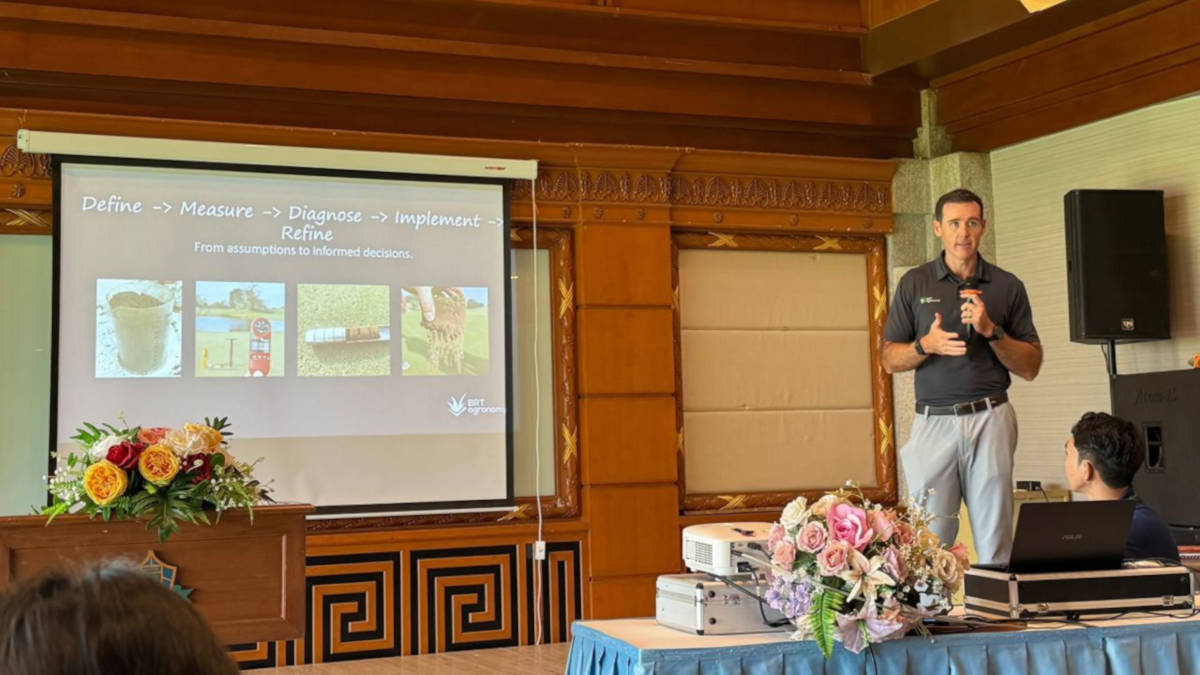
BANGKOK - In the high-stakes world of golf course management, taking immediate action can feel like the fastest route to progress. However, according to industry consultant Brad Revill, jumping straight into solutions without proper groundwork is often the most expensive mistake a club can make.
Speaking at a recent industry seminar hosted at the Panya Indra Golf Club in Bangkok, Revill addressed an audience of course owners, general managers, and superintendents on a core vulnerability facing modern golf facilities: poor operational sequencing.
"Most golf clubs don’t have an advice problem; they have a sequencing problem," Revill shared in a post following the event.
During his presentation, Revill outlined a structured five-stage framework designed to safeguard course health and ensure long-term capital efficiency: define, measure, diagnose, implement, and refine.
While many facilities are eager to resolve turfgrass issues, structural maintenance challenges, or agronomic declines quickly, Revill highlighted that skipping the initial diagnostic stages routinely leads to costly errors. When decision-makers leap directly to the "implement" stage, they risk treating symptoms rather than root causes - leading to repeated expenditures on short-term fixes rather than lasting improvements.
"The expensive mistakes usually happen when a club jumps straight to 'implement,'" Revill explained, reinforcing why third-party expertise often yields returns that far exceed its upfront cost.

The value of independent advice, Revill argued, lies precisely in its ability to enforce disciplined problem-solving. External consultants offer objective assessments free from internal biases or operational pressure to deliver immediate, superficial results. By systematically defining the baseline conditions and measuring environmental and structural parameters, course managers can diagnose precise issues before committing significant budget to implementation.
The seminar brought together key decision-makers across the Southeast Asian golf sector to discuss best practices in course sustainability, maintenance, and asset management. Attendees engaged in discussions centered on how structured methodologies can improve turf performance, streamline operational budgets, and enhance overall guest and member satisfaction.
Following the successful workshop, Revill expressed his appreciation to event organizers and hosts. "Thank you to Great Minerva for the invitation, and to Panya Indra Golf Club for the fantastic hospitality," he noted.
As golf facilities continue to navigate shifting climate patterns, rising operational costs, and increasing member expectations, the shift toward structured, diagnostic-first management is becoming essential. For owners and managers looking to protect their bottom line, Revill’s message was clear: getting the sequence right is just as important as the solution itself.
Related article:
 |
Why Independent Agronomy Advice MattersWhen technical advice is connected to the products and equipment a golf course buys, independence is worth considering. |