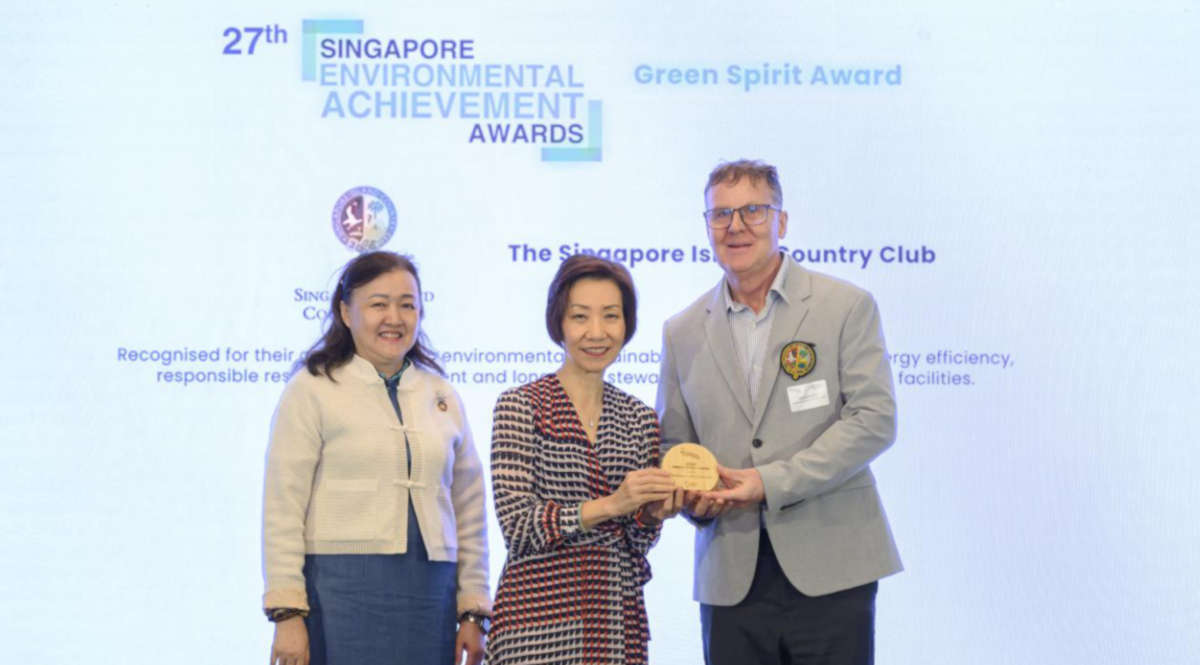
(L to R): Ms Isabella Huang-Loh, PBM, Chairman, Singapore Environment Council, Ms Grace Fu, Minister for Sustainability and the Environment and the Minister-in-charge of Trade Relations, and Mr Ian Roberts, SICC General Manager.
SINGAPORE — 27 August 2026 — The Singapore Island Country Club (SICC) has been awarded the Green Spirit Award at the 27th Singapore Environmental Achievement Awards (SEAA) 2026. Organised by the Singapore Environment Council (SEC), the SEAA recognises organisations for environmental stewardship and measurable improvements in environmental performance. The award was presented by Ms Grace Fu, Minister for Sustainability and the Environment and Minister-in-charge of Trade Relations, at PARKROYAL COLLECTION Marina Bay on 26 August 2026.
The recognition comes as SICC advances towards its ambition of achieving carbon neutrality by 2030, while addressing the operational challenge of maintaining high-quality playing conditions across its three golf courses while using water, energy, and other resources more efficiently.
Speaking on the award, SICC General Manager Mr Ian Roberts said:
"This award is significant because it recognises that sustainability is becoming part of how we operate SICC, rather than being treated as a standalone environmental initiative. Operating three golf courses comes with considerable environmental responsibility. Our approach is to make practical, measurable improvements across the Club, whether through renewable energy, smarter water management, electrification, resource recovery or biodiversity conservation.
"There is still much more to do, but the Green Spirit Award gives us encouragement to keep improving and working towards our goal of carbon neutrality by 2030."
SICC established its carbon baseline at 8,516 tonnes of CO₂ equivalent in FY2023/2024. Excluding the one-off impact associated with the replacement of ageing chiller equipment, its FY2025/2026 carbon footprint would have been approximately 8,102 tonnes, representing a 4.9% reduction from the baseline. Scope 2 emissions from purchased electricity also fell by 6.9%.
To drive energy efficiency, SICC installed solar panels at its Island location, which generated renewable electricity on site and reduced reliance on grid-supplied electricity, delivering the Club’s largest measurable environmental saving to date.
The Club has also installed a Battery Energy Storage System (BESS) at its Island location to manage electricity demand. By storing energy and smoothing peaks in demand, the system reduces strain on electrical infrastructure, supports Club operations, and enables SICC to participate in the Energy Market Authority’s Demand Response Programme.
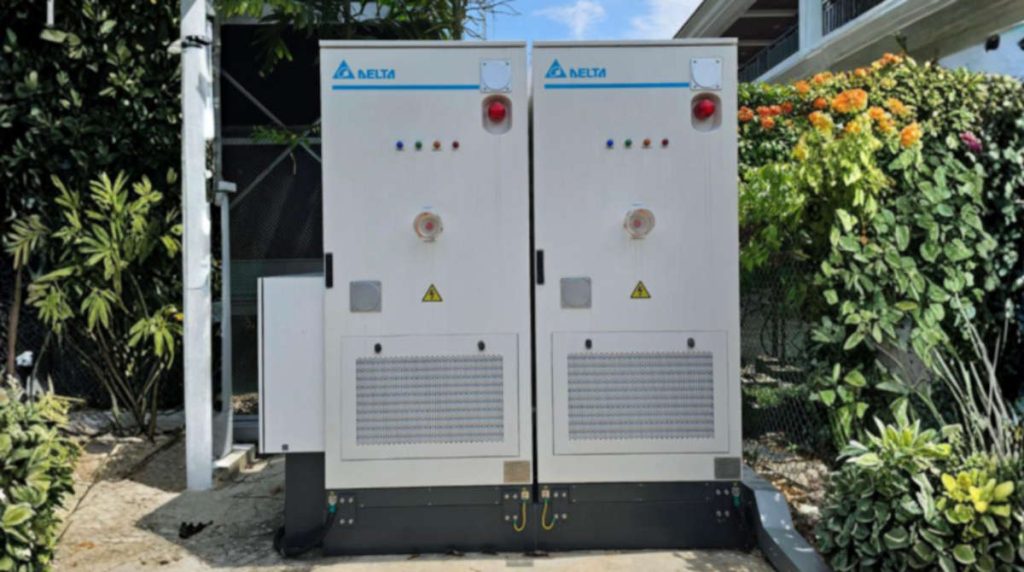
Battery Energy Storage System (BESS) at Island location
SICC is applying precision resource management directly across its golf courses. Because water represents one of the largest environmental impacts of golf-course operations, the Golf Course Maintenance team uses soil-moisture data and on-ground assessments to guide irrigation rather than applying water uniformly across the courses. This enables targeted water application, reducing unnecessary consumption while maintaining turf health and consistent playing conditions.
The Club is also progressively replacing conventional course maintenance equipment with electric alternatives. Its electric greens mowers produce zero direct emissions during operation, require no petrol or engine oil, and operate significantly quieter than conventional petrol-powered equipment, contributing to a cleaner and quieter environment for Members and staff.
SICC is also recovering and reusing natural resources within its landscape. When trees fall during severe weather or need to be removed for safety or playability, suitable timber is recovered and repurposed into course features, such as distance markers and a new 10m tee marker at The Island Course. The trunks are air-dried and processed locally, reducing waste, off-site disposal, and transport emissions while replacing synthetic or polyethylene-based materials with timber sourced directly from SICC grounds.
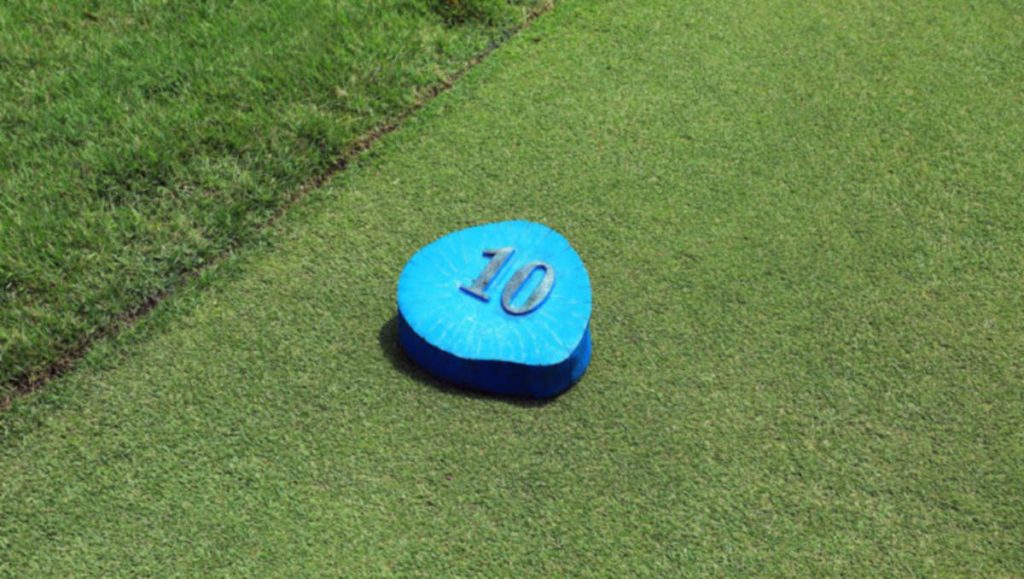
New 10m tee marker at The Island Course
Beyond material recovery, SICC is actively propagating native plant species found on its courses. The Golf Course Maintenance team collects seeds from native trees and nurtures them into saplings for replanting.
A key focus of this initiative is Alstonia pneumatophora (Marsh Pulai), a species with fewer than 20 known specimens in Singapore. After a specimen on SICC's course flowered, the Club's arborist collected its seeds and successfully propagated new saplings.
SICC has shared these saplings with other golf courses, including Tanah Merah Country Club and Laguna National. Additionally, seeds collected from SICC's courses are shared with NParks' Native Plant Centre for propagation and recorded in the Singapore Botanic Gardens Herbarium repository.
Addressing the Club's dual operational and environmental role, Mr Roberts added:
"A golf course is not only a sporting environment. It is also a living landscape. We have a responsibility to look after that landscape and the biodiversity within it. For us, good environmental management and good golf-course management should go hand in hand. Technology and better data increasingly allow us to deliver the playing conditions our Members expect while being much more precise about the resources we use."
The Green Spirit Award marks a milestone in SICC's sustainability journey as it continues to examine opportunities to reduce emissions associated with energy, fuel, fertiliser, materials, transportation, and its wider supply chain. Future plans include further electrification, expanded renewable energy, greater resource efficiency, and sustainable procurement.
SICC's approach remains centered on continuous measurement and improvement: identifying environmental impacts, locating areas for maximum gains, and progressively embedding those improvements into daily operations toward its 2030 carbon neutrality target.