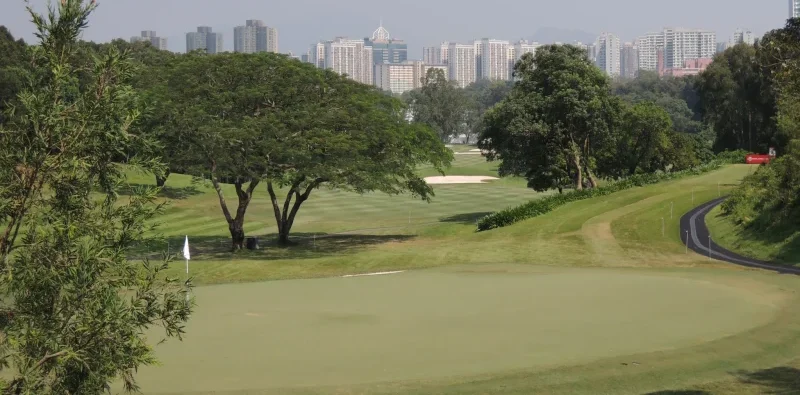
Hong Kong’s Court of Appeal has dismissed the government’s appeal against a 2024 High Court ruling that quashed the environmental approval for a proposed public housing development on part of the Fanling Golf Course.
A three-judge panel led by Chief Judge Jeremy Poon handed down the decision on Monday, upholding the Court of First Instance’s finding that the Director of Environmental Protection had not acted in accordance with the law when approving the project’s environmental impact assessment (EIA) report.
The proceedings centred on the EIA process rather than the government’s decision to reclaim the land or its broader housing plans. In 2023, authorities resumed 32 hectares of the 172-hectare course after the relevant land lease expired. Of that area, 9.5 hectares were earmarked for approximately 12,000 public flats intended to house around 33,600 residents.
The Hong Kong Golf Club had successfully challenged the EIA approval in the High Court, arguing that the process suffered from inadequate public consultation and insufficient consideration of ecological and heritage impacts. The appellate court agreed that the consultation was unfair. Supplementary information submitted by the Civil Engineering and Development Department—including surveys on affected bird and moth populations—was not made available for public inspection, and the golf club’s responses to that material were not properly taken into account.
The judges further ruled that conditions attached to the approval by the Environmental Protection Department effectively required a substantial redesign of the project, including revised layout plans, woodland preservation measures and new design submissions. Such requirements, the court found, fell outside the permissible scope of conditional approval and improperly deferred key decisions to a later stage.
The judgment also addressed the EIA report’s treatment of protected trees and the cultural heritage impact on the “Old Course,” recognised as the oldest golf course in China. The lower court had previously described the classification of that impact as “undetermined” and “irrational,” observing that the effect was “blindingly obvious.”
The government had argued that the judicial review had become academic following a June 2023 amendment to the Environmental Impact Assessment Ordinance that removed the project from the list of designated developments requiring such assessments. The Court of Appeal rejected that contention, holding that the approval remained a live issue because the EIA report could still be relied upon for other purposes under the ordinance.
The Director of Environmental Protection and the Civil Engineering and Development Department were ordered to pay the golf club’s costs of the dismissed appeal.
The Development Bureau had previously indicated that the original High Court decision would have a substantial impact on housing yield and completion timelines. The latest ruling reinforces the legal constraints on the environmental approval process for the Fanling site and is widely expected to require a fresh round of public consultation if the housing project is to proceed.
Looking ahead, the Hong Kong Golf Club has welcomed the judgment and described the Old Course as a “precious living heritage” that remains pivotal to the development of the sport in Hong Kong. A club spokesman said it will continue to communicate with the government in the hope of preserving the Old Course while generating the greatest value for the city by fully utilising the club’s resources and facilities, in line with government policies of promoting golf and sports tourism. The government has indicated it will study the judgment in detail with its legal team and announce its next steps in due course, which could include a further appeal to the Court of Final Appeal.
For the original story, please visit Hong Kong Free Press