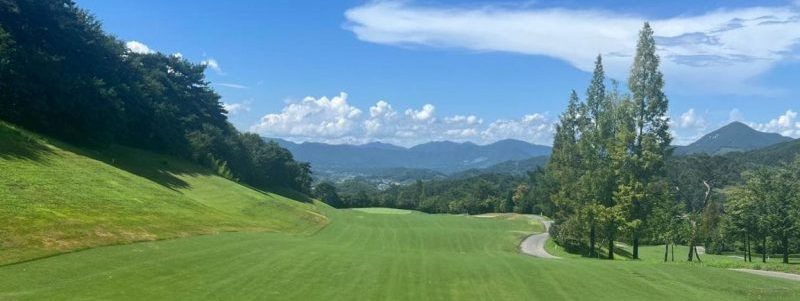
Golfzon County, South Korea’s largest golf course owner and operator, has purchased 80 metric tons of Tahoma 31 Bermudagrass sprigs from Vietnam-based Outfield Nursery Enterprises (ONE) to convert 27 holes at its GC Suncheon facility.
The switch from Kentucky bluegrass fairways to Bermudagrass is uncommon in Korea. Golfzon County CEO Seo Sang Hyen oversaw the two-phase project across the past two summers. The conversion has addressed both rising golfer expectations and the practical effects of a warming climate.
“Golfzon County’s long-term strategy is anchored in scalable efficiency, climate resilience, and delivering an elevated guest experience across our entire portfolio,” Seo said. “As regional climate patterns continue to evolve, relying on legacy agronomic models is no longer viable. Cool-season grasses have become cost-prohibitive to maintain, while traditional zoysiagrass lacks the rapid recuperative capacity required for high-volume operations. The agronomic data on Tahoma 31 – particularly its cold hardiness, low water demands, and aggressive recovery – proved decisive.”
Golfzon County operates more than 20 clubs in South Korea. GC Suncheon, located in Juam-myeon, Suncheon, Jeollanam-do at about 35.05 degrees north latitude, had experienced ongoing difficulties with Kentucky bluegrass under rising heat and humidity. The summer of 2024 was particularly severe.
The company’s research identified Outfield Nursery Enterprises as the regional distributor for Tahoma 31 across most of East Asia. ONE is headquartered in Hong Kong and grows improved Bermudagrass varieties at its farms in Vietnam.
In mid-2025, ONE supplied 54 tons of washed, refrigerated Tahoma 31 sprigs from its Da Nang farm. Golfzon County used a Bermuda King no-till row planter to inter-sprig the 18-hole course in five days.
“Our first site review took place in late August 2025, two months after the inter-sprigging,” said ONE Managing Director Rob Glucksman. “The first hole looked great. By the time we passed the second tee we could see the programme had delivered as expected. The course reopened the following week on 1 September. When we checked again in November 2025 there was very little residual Kentucky bluegrass.
The combination of summer heat, irrigation, fertility and a Primo programme created favourable conditions for conversion. A further visit in spring 2026 confirmed the fairways were performing well after only about six months of good growing weather.”
Golfzon County then ordered an additional 26 tons of sprigs in early 2026 to convert the remaining nine-hole loop. For the narrower fairways and tighter areas around greens and bunkers, the club used ProCore aerifiers rather than the Bermuda King planter.
Trial plots of Tahoma 31 have also been established at several cooler sites closer to Seoul.
Bermudagrass fairways were long considered unsuitable for much of Korea. Earlier varieties handled the hot summers reasonably well, especially in the south, but often failed to survive colder winters further north.
Suncheon’s latitude is comparable to transition-zone locations in Maryland and Virginia in the United States. Released in 2017 after more than a decade of development at Oklahoma State University, Tahoma 31 has extended the practical range of Bermudagrass in similar climates on both sides of the Pacific.
Conversion methods have also advanced. Traditional sprigging into existing bluegrass could take one to two years for the Bermudagrass to dominate. Current summer inter-sprigging techniques accelerate the process. High temperatures and humidity already weaken cool-season grass; intensive watering and fertilisation further favour the Bermudagrass, allowing conversion with limited downtime.
“From a management standpoint, the rapid establishment rate of Tahoma 31 was critical in minimising lost operating tee times,” Seo said. “Post-conversion we have recorded measurable reductions in summer fungicide use, irrigation demand and heat-stress management costs. The vigorous summer growth requires proactive mowing and thatch control, but the overall agronomic profile is now more predictable.”
Tahoma 31 still goes dormant in winter. South Korean golfers are generally accustomed to dormant fairways in late autumn and winter. Seo noted that the variety produces a deeper green colour and finer texture than traditional zoysiagrass, with a firmer, denser surface. Golfer feedback has been positive on uniformity and consistency during the growing season.
Both ONE and Golfzon County are monitoring the northern trial plots, given the concentration of courses around Greater Seoul. Tahoma 31 has shown good survival in comparably cool locations, including the mountainous north of Vietnam, where it was used on the IMG-designed Sapa Grande course in 2024.
“Seoul experiences colder temperatures for longer periods than Suncheon,” Glucksman said. “Last winter the grass survived a week of daytime highs of –4°C and night-time lows below –10°C in southern Maryland and Virginia, with little damage. As a Bermudagrass it also has the advantage of recovering quickly once temperatures rise.”
Original story and Image credit to Mandarin Media